Observation 01 / Ego
The Ego Has Entered the Chat.
The small self—with a surprisingly large public-relations department.
Notes from the human situation
Personal observations on the strange things we do, the stranger things we accept—and the everyday chaos we confidently call normal.
Six observations are ready to read. Two more are waiting their turn. The subject is us.
The small self—with a surprisingly large public-relations department.
Traffic can see you. The red light has heard you. Nothing has moved.
The eyes look. The hands move. The thought about everyone else never arrives.
Some cars have a registration number. Others have a résumé.
The phone is at his ear. The road is apparently everyone else’s responsibility.
We count the thrill. Someone else counts the cost.
A word. A scooter. A parking space. Why is everyone one small trigger away from a fight?
A species clever enough to reach space, still fighting over lines it drew itself.
It is unacceptable when you do it. When I do it, there is context.
Buy a car. Feel important.
Buy a bigger car. Feel more important.
Get a house, a good-looking face, a title, a few followers—or a position in politics—and suddenly the world is expected to notice.
But what exactly is this ego built on?
There are more than eight billion people on Earth. India alone has over 1.4 billion. Each of us is one person among them, sharing the planet with countless other species.
Zoom out. All human bodies together account for roughly 0.01% of the mass of living things on Earth, measured by carbon. The Sun holds about 99.8% of the mass of our solar system. And it is just one of more than 100 billion stars in the Milky Way.
Somewhere in all that, I have bought a new SUV and decided I am above saying thank you.
What the F… life?
The strange thing about ego is how easily it breaks. A job title can disappear in an email. A house can disappear in an earthquake. An image we have spent years building can be shaken by a single sentence from someone else.
If one word can shatter it, how powerful was it in the first place?
Perhaps ego grows because we know how fragile we are. We collect money, status, attention and authority to feel bigger, then begin to believe these temporary things are us.
Being small, though, does not make our actions small. This tiny species has changed the climate of an entire planet. And decisions made by a handful of powerful people can affect millions of lives.
So the answer is not to believe that nothing matters. It is to question why we need to feel superior in order to matter.
This is where gratitude can do what ego cannot.
Ego says, Look what I have.
Gratitude says, How fortunate I am to have had it.
Ego depends on the car, the house, the title and other people’s approval. Gratitude can remain even when those things change. No one can take back the fact that we were loved, helped, given an opportunity or allowed another morning to begin again.
Enjoy the car. Be proud of the house. Celebrate what you have built.
But if it all makes you look down on someone else, perhaps it is time to replace a little ego with gratitude.
The Milky Way has not heard of your promotion. The person who helped you get there might appreciate a thank-you.
There is traffic ahead.
You can see it. The driver behind you can see it. The driver behind him can probably see it from another postal code.
And then: HONK.
Perhaps the sound will lift the cars into the air. Perhaps the red light will feel embarrassed and turn green. Perhaps the traffic jam has simply forgotten to move and needs a reminder.
On Indian roads, we have developed a remarkable way of driving without looking. A vehicle edges slightly to the left? Honk. Someone slows down ahead? Honk. The road is empty, but there could be someone around the corner? A small advance honk, just to introduce yourself.
The horn was meant to warn people of danger. We use it to announce our feelings.
Some of this behaviour is learned before we ever take a driving test. A father drives with one hand on the wheel and the other on the horn. His son grows up watching. Years later, the son teaches his own child that an indicator is optional, a pedestrian is an inconvenience, and a horn is a personality.
Congratulations. The family tradition continues.
Our roads and leaders deserve scrutiny too. A new flyover looks impressive in a photograph. Teaching people to drive, making crossings usable, and enforcing road rules are less glamorous jobs. Yet a road is only as safe as the behaviour it permits.
But we cannot blame the government for the thumb pressing our horn. The person doing it may have a degree, a good job, and a car full of safety features. Somehow, none of these guarantees the ability to wait six seconds.
Let’s say the uncomfortable part out loud: too many of us are simply dumb drivers. Not because we lack intelligence in every part of life, but because the moment we enter a vehicle, common sense seems to leave through the window. We overtake blindly, ignore indicators, drive too fast, treat lanes as suggestions, and honk as if noise can replace judgment.
That stupidity is not harmless. It shows up in accident numbers, injuries, deaths, and families permanently changed by a few seconds of reckless driving. We are not merely impatient; we are dangerously careless. By any honest measure of road discipline, we are among the dumbest drivers in the world.
The strangest moment is when a driver honks at a pedestrian crossing the road. A person, exposed to traffic, is trying to get across. The driver is inside a metal box and decides that he is the one who needs more space.
There is a little ego in that sound, isn’t there?
Buy a car and suddenly the road feels like your living room. Everyone else is in the way. The horn becomes a button that makes people notice you. Maybe it carries impatience. Maybe it carries anger from a day in which nothing went your way. Whatever the reason, the person walking in front of you did not sign up to receive it.
A horn can warn someone. It cannot clear a traffic jam, repair a pothole, change a signal, or make a pedestrian vanish. And if you are using it every few seconds, people may stop hearing the one honk that actually matters.
So here is a radical proposal: drive with your eyes.
See the traffic and slow down. See a person crossing and give them time. Use the indicator to tell others what you plan to do. Keep the horn for danger.
If nothing is moving, the road already knows.
It does not need your commentary.
There is common sense. There is civic sense. And then there is a car parked in front of your gate.
Not for two minutes. For three hours.
The driver returns and looks surprised that you needed to leave your own house.
Did he see the gate? Of course. Did he notice that it belonged to a world containing other people? Apparently, that part of the mind was asleep.
This is the thought I keep coming back to. We are doing things without being present for them. The eyes look. The hands move. The horn sounds. The wrapper leaves the car window. Somewhere between seeing and acting, the thought that says wait, what happens next? never arrives.
Eyes open. Attention closed.
A wrapper in your hand? The road will take it. A bike to park? The footpath has room, provided nobody wants to walk. Traffic ahead? Honk. The driver is looking straight at the jam and still asking it to move through the power of sound.
Most people know where rubbish belongs. They know a gate is an entrance. They know a horn cannot dissolve traffic. So perhaps this is not a shortage of information. It is the disappearance of a small thought about the person who comes next.
Someone else has to walk past the rubbish. Someone else has to get through the gate. Someone else has to hear the horn.
That is what civic sense seems to be: common sense with other people included.
Ego makes the whole thing louder. The person honking at a pedestrian and the person blocking an entrance are saying the same thing without opening their mouths: my next five minutes matter more than your day.
And it is hardly confined to roads.
The plane lands. Before it has finished moving, people stand up, fold themselves beneath the overhead bins, and wait in a crooked line that cannot go anywhere. At the boarding gate, someone joins a queue long before their group is called, then gets impatient with the queue they helped create. In a quiet waiting room, someone takes a call on speakerphone. The rest of us apparently joined the call by sitting nearby.
The body is busy. The mind has logged out.
Each incident seems too small to discuss. That is how they pile up. One person causes a tiny inconvenience; ten others absorb it. Repeat that all day, everywhere, and suddenly a public place feels exhausting.
We could blame younger people, except they learned by watching older people. A child sees a parent toss a packet out of a car. A teenager watches an adult park across a gate and say, “Just five minutes.” Later we are shocked to find the lesson has been remembered.
Congratulations. The family tradition continues.
And the people running things? Politicians from every party seem remarkably good at politics and remarkably dumb about this. They can turn a chapter about an emperor into a national argument. Meanwhile, the person outside the school throws a cup on the pavement and drives away. Perhaps it is easier to fight over what children should read than to notice what children are watching.
I do not think this is an Indian gene, or that everyone elsewhere is quietly placing rubbish in a bin. Mindlessness travels well. But here, it can feel as though the entire street has agreed not to notice the next person.
The gate is visible. The footpath is visible. The traffic is visible.
People are looking.
That is not quite the same as seeing.
There is no right or wrong here. I am not judging anyone for having a label.
My own car has one: India Book of Records holder for an EV convoy to Bhutan. I put it there. I like it. So I am very much part of the species I am writing about.
And what a species we are.
A doctor retires, turns ninety, and the nameplate still says DOCTOR in letters large enough to diagnose you from across the street. A former mayor remains the first mayor on the back of a car ten years later. Somewhere in traffic is a SPEAKER, an ADVOCATE, an EX-CHAIRMAN, and a designation I have never heard of but am apparently expected to respect.
Some cars have a registration number. Others have a résumé.
The achievements may be real. Becoming a doctor takes years. Being elected mayor is a big deal. Driving an EV convoy to Bhutan took effort too. The funny part is our need to carry the achievement everywhere, as though leaving the title at home might make us smaller.
Ask someone who they are and the answer often arrives as a job.
“I’m a builder.”
“I’m a lawyer.”
“I’m a businessman.”
We rarely say, “I’m a person who builds things.” The work starts as something we do. Slowly it becomes who we are.
Years ago, someone I knew who worked at Facebook said something that stayed with me: “I’m in Facebook, but Facebook isn’t in me.”
I loved that. A job can take up eight hours of your day without taking over your identity. Your company can be on your visiting card without moving into your soul.
But labels are wonderfully convenient. They introduce us before we have to say anything. They tell strangers what we achieved, where we work, whom we know, or who we used to be. A label is a little piece of external proof that says, I am somebody.
And perhaps that is why we hold on so tightly. Without it, we might have to meet each other as ordinary human beings.
As we say in Hindi, ऐरा-गैरा नत्थू-खैरा. Nobody wants to be an ordinary somebody. Every ordinary somebody wants a title.
Then you zoom out.
Scientists estimate that Earth is home to roughly eight million animal and plant species. Humans are one of them. There are more than eight billion of us, each busy collecting names for the small portion of life we spend working, winning, retiring, and remembering when we were important.
Out of all the lives on this planet, we happen to be here: alive, breathing, human. That alone could inspire a little gratitude.
Yet HUMAN is the one label you will almost never see on a nameplate.
Doctor, lawyer, accountant, builder, minister, former minister, former minister’s former adviser—yes. Human? Apparently too ordinary to mention.
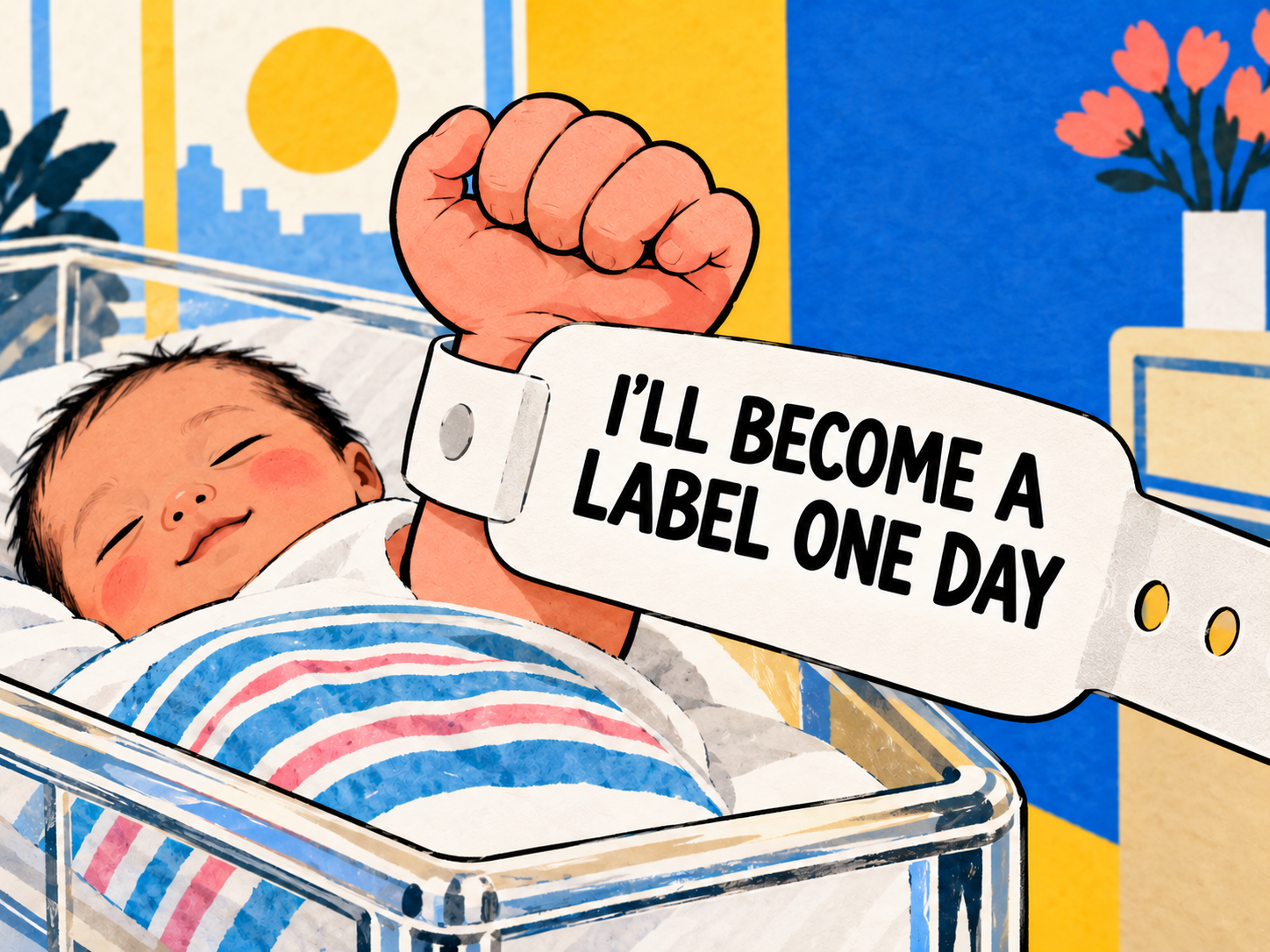
Maybe that is why the image of a newborn in a hospital makes me laugh. The child has barely arrived. There is a tiny wristband to say who they are. Imagine if it already said:
I’LL BECOME A LABEL ONE DAY.
Give the child a minute. They have only just started breathing.
We arrive with a pulse. Somewhere along the way, we decide it needs a job title.
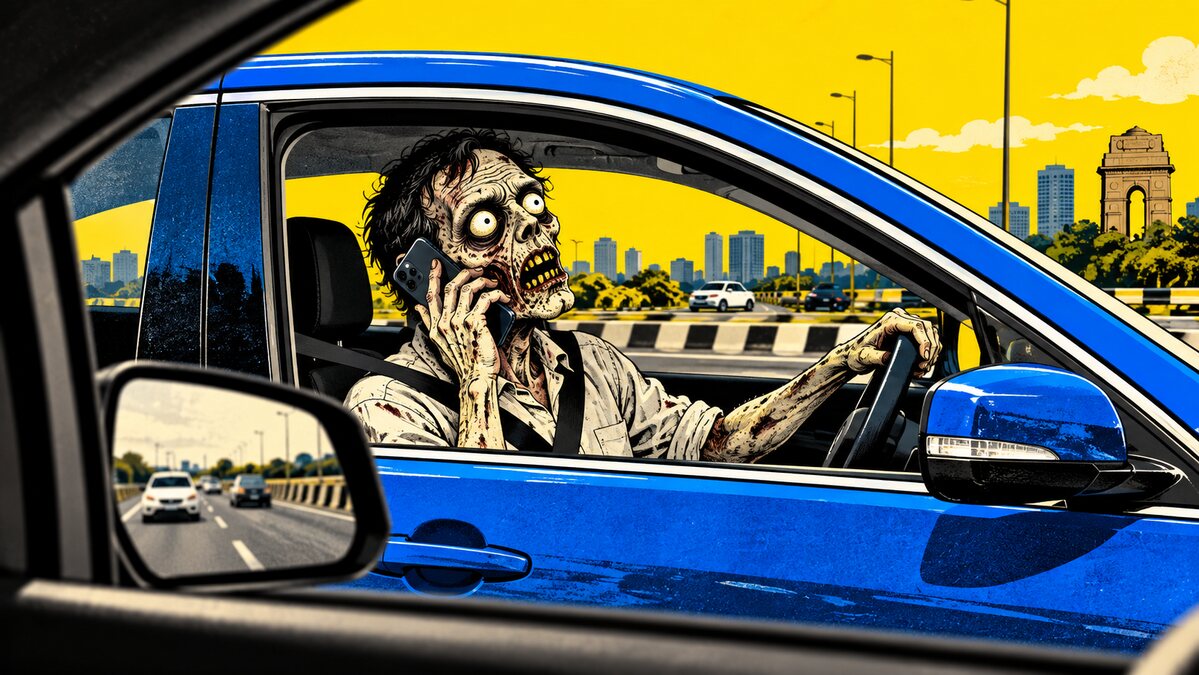
You’re on the Gurgaon highway. Traffic is moving, until one car in the middle lane begins drifting along at half the pace of everyone around it.
You pass it carefully and glance inside.
There he is. Alone in the car. One hand on the wheel. The other holding a phone to his ear.
The zombie has been identified.
Then comes the best part. You look at him. He looks straight back, phone still pressed to his ear, with an expression that says: What the F are you staring at? Haven’t you ever seen a man conduct important business in traffic?
For a moment, he seems convinced you’re the strange one.
His car has Bluetooth. His phone has a speaker. Both inventions have been around long enough to have children who can drive. Yet this clueless, careless driver has chosen to hold the phone to his head while steering a moving vehicle. Perhaps the deal is so important that it requires the phone to be physically attached to his ear.
And this is hardly one unusual driver. According to a deeply unscientific survey conducted by my own eyes while driving, it feels as though more than half the people I see are on their phones. Cars, bikes, buses, trucks, tempos—the vehicle changes; the phone does not. The figure is my impression, but the sight has become impossible to ignore.
Some are talking. Some are looking down and typing while their vehicles wander across the road. And then there is the advanced species: the driver who mounts a phone on the windscreen and plays a movie. The very glass through which he is supposed to see the road has become a cinema screen. Everyone else can apparently watch the traffic for him.
We have all taken calls while driving. I’m not pretending to be above it. But these reckless, distracted drivers behave as though the road—and every person on it—can wait for them.
They come in every variety: educated, uneducated, literate, illiterate. You could have a degree from Harvard—or from India’s Harvard, Amity—and still be dumb enough to hold a phone to your ear in a car that could connect to it. A degree may help you buy the car. Apparently, it cannot make you use what came with it.
You can usually spot this driver before you see the phone. He slows unpredictably. He occupies the middle of the road. His indicator is on holiday. His eyes are open, but his attention is somewhere in a conversation about a meeting, a delivery, or what to have for dinner.
What do you call someone so unaware of the vehicles around him? Clueless? Entitled? Spectacularly stupid? The dictionary is going to run out of adjectives before Indian roads run out of examples.
It is the same family of behaviour we see everywhere: honking at a traffic jam, treating pedestrians as obstacles, parking across someone’s gate. Ego says, my business matters most. Mindlessness says, someone else will manage. The person in the next lane has to survive both.
India may be overlooking a spectacular source of revenue. By my entirely unscientific estimate, traffic police could issue ₹50–60 crore worth of challans a day if they caught every driver texting, holding a phone, ignoring a lane, or inventing a new use for the horn. The queue of dumb, arrogant and dangerously distracted customers would never end.
And yes, a hands-free call does not magically restore your attention. But if you cannot even free the hand holding the phone—or put it down when the conversation can wait—what exactly are you doing behind the wheel?
If a zombie apocalypse ever arrives in India, we might miss the announcement.
We’ll be too busy driving around it.
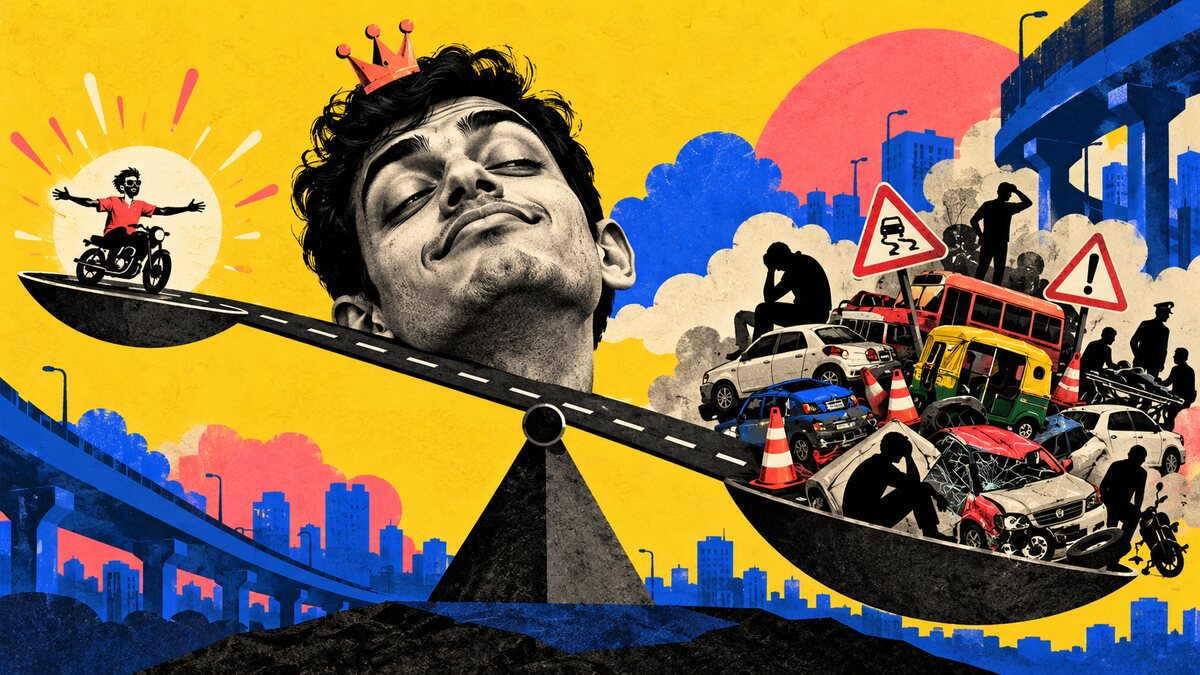
Someone drives at 150 on a busy road. He weaves between cars, arrives at the next red light twelve seconds before everyone else, and looks pleased with himself.
What did he gain? A little thrill. Perhaps a story to tell.
What did he risk? His life, your life, the person crossing ahead, and a family that has no idea it is about to become part of his story.
Every choice has a risk and a reward. We may not call it a risk–reward ratio in our heads, but we make the calculation all day. Is this worth doing? What might happen if I do it?
The problem is that some of us are extraordinarily good at counting the reward and spectacularly bad at counting the risk.
The thrill of speed? Ten out of ten. The chance of hurting someone? Apparently zero, because it has not happened yet. This is an impressive assessment, provided you have the judgment of a potato with a driving licence.
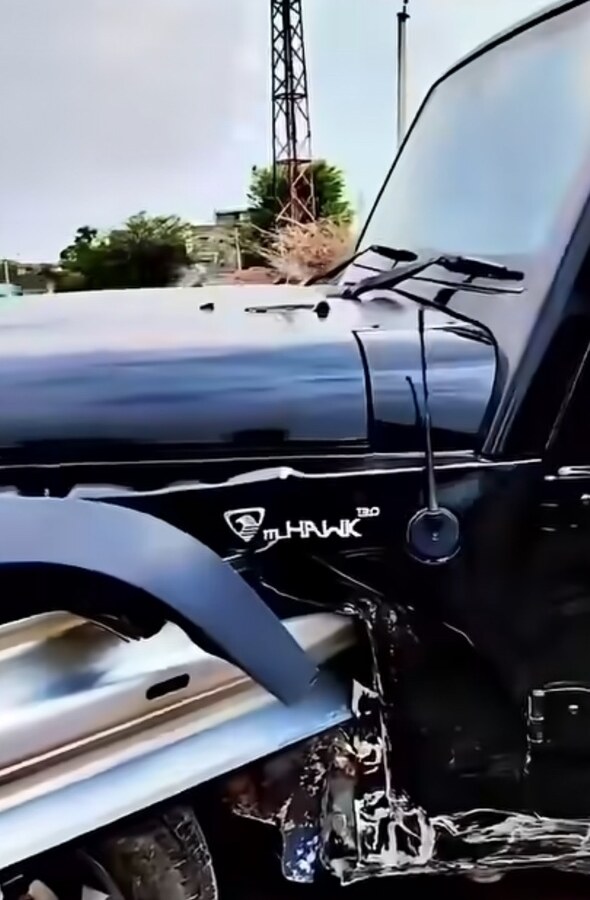
Here are three frames from the road. A damaged vehicle. People trying to right an overturned car. A Jeep against a barrier. The images do not tell us who caused each incident. They do show that the word risk refers to something more substantial than a fine or a delayed arrival.
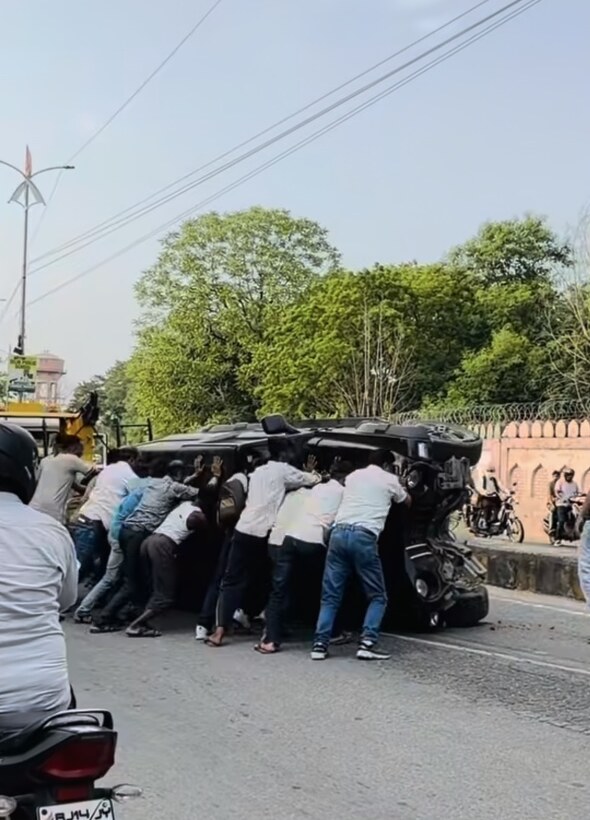
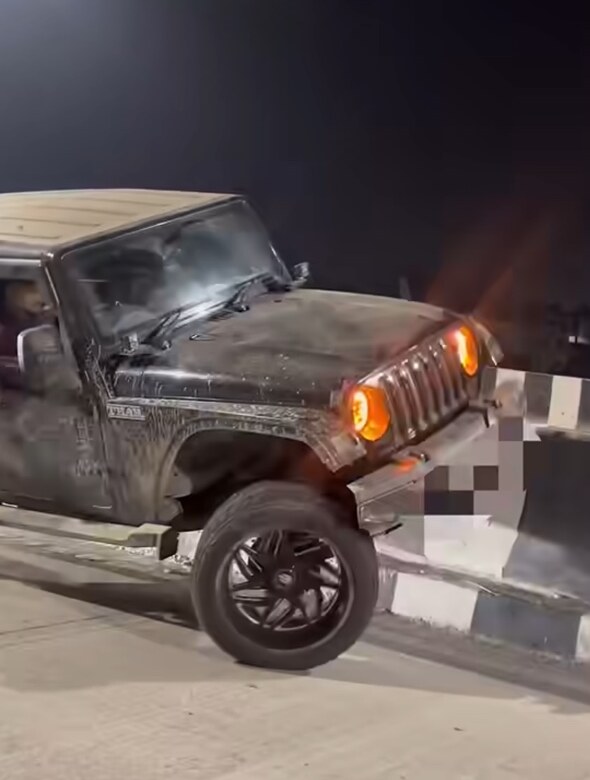
You see the same calculation in smaller acts. Park across a gate and save yourself a short walk. Throw a wrapper out of the window and keep your car clean. Check your phone while driving and answer an urgent message that says “okay.” Each reward is tiny. The inconvenience or danger is handed to somebody else.
We count what we gain and leave other people to count what it costs.
I don’t think every reckless person has carefully decided that others do not matter. Many simply never reach the part of the thought where others appear. Ego takes the front seat. Awareness gets left somewhere near the last toll plaza.
Education ought to help us pause and assess a consequence. Yet a degree can coexist quite comfortably with a dim-witted decision. You can read a balance sheet, run a company, and still behave like a clueless, entitled, self-important clown the moment a steering wheel enters your hands.
Then there is the moral compass. I suspect many of us still have one. It is just remarkably easy to mute when it points away from what we want. I’m only doing it for a minute. Everyone else does it. Nothing will happen.
Nothing happens—until something does.
Indian roads give us a daily parade of this thinking: the impatient, the oblivious, the reckless, the casually dangerous, the proudly inconsiderate. One moron’s reward can become a stranger’s lifelong loss. That is what makes the behaviour more than merely annoying.
Perhaps the question is not “Why are people so stupid?” Plenty of intelligent people do stupid things. The more uncomfortable question is: when we decide what is worth doing, who gets included in the calculation?
If the answer is only me, even a tiny reward can look enormous.
And the rest of the world becomes an acceptable risk.
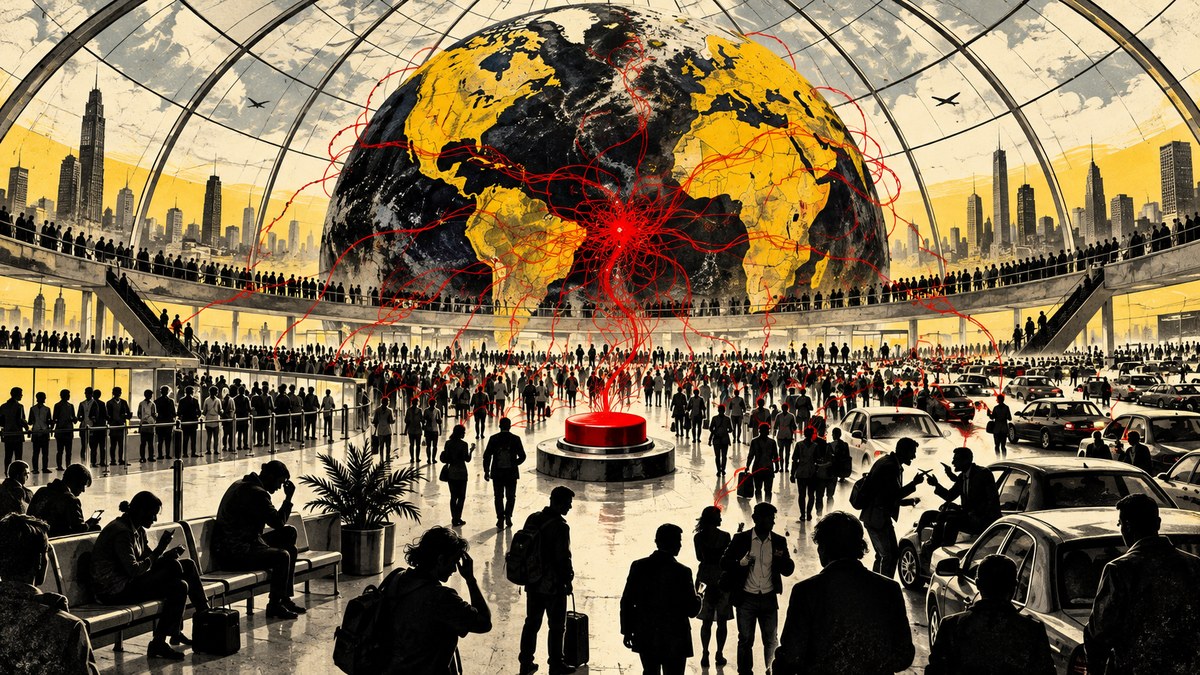
A scooter comes a little too close. Someone takes a parking spot. A stranger says one sentence in the wrong tone. That is apparently all it takes now. The argument begins, the shouting follows, and sometimes someone gets hurt or killed over something that should have been forgotten before lunch.
What are we all carrying around that a tiny trigger can set off so much anger?
This is the part we keep missing when we call it “just bad behaviour.” If someone repeatedly loses control over a word, a smell, a car or a scooter, threatens people, or seems ready to hurt a stranger, perhaps that person needs a mental-health assessment. We talk about the fight, the traffic and the video that goes viral. We rarely talk about whether the person was well in the first place.
The frightening thing is how ordinary it can look until the moment it isn’t. Someone goes to work, buys groceries, chats with a neighbour—and then a parking dispute flips a switch. Suddenly, a person they have never met becomes an enemy worth attacking. A parking space has somehow become more valuable than another human being.
It can feel like living in an asylum without walls. The triggers are everywhere, help is nowhere in sight, and several people in the waiting room have car keys. I mean that as a picture of how the world feels, not a diagnosis of everyone who gets angry. But repeated rage and threats are warning signs. Why do we wait for someone to get hurt before asking whether the person needs help?
Our risk–reward calculation has also gone completely upside down. The reward is five seconds of feeling powerful: I showed him. I won that argument. The risk is another person’s life, your own life, or both. What kind of mind looks at that bargain and says, “Excellent deal”?
And this is no longer something we can dismiss as “old people being difficult.” Perhaps we once expected a few people in their seventies to be stubborn, set in their ways, or out of touch. Now you can see the same hair-trigger anger in someone who is seventy-five, forty-five or twenty-five. The trigger has no age limit.
The irony gets bigger when you look at who holds power. In a family, we might question whether a seventy-five-year-old understands enough about a changing world to make every decision for everyone at home. Yet a handful of older leaders make decisions affecting entire countries—and sometimes the planet. Look at the United States, Russia and China. Enormous power sits with a few men who have been at the centre of politics for decades. Experience can bring wisdom, of course. It can also bring an ego that has gone unchallenged for far too long.
But this is not an old-age problem. On our streets, in our offices and in our homes, younger people are showing the same explosive reactions. A word, a scooter, a parking space—and suddenly another human being is an enemy. Whatever is happening to our patience and mental health, it is reaching across generations. Calling it “how people are these days” does nothing for the person who may need help or the person standing in their way when they lose control.
Courtesy, consideration and empathy sound like words from a language we used to speak. Now the question seems to be: How dare this other person inconvenience me for three seconds? The scooter rider is furious with the car. The car driver is furious with the pedestrian. The pedestrian is furious with everyone. Congratulations, we have invented a traffic system powered entirely by unresolved feelings.
I don’t know how many people are struggling, and I won’t pretend I can diagnose them from across the road. I do know that a person who is constantly one small trigger away from violence needs more than another argument. They may need help. The people around them need safety. Both things matter.
When a sentence, a scooter or a parking spot is enough to make someone want to hurt another person, something has gone badly wrong long before the fight begins.
A place to notice human behaviour, laugh at it—and occasionally remember that we are the humans.
Get a note when a new observation lands. We already have enough notifications.